
How applied neuroscience helps clinicians understand what is happening beneath the symptoms—and choose what to do next
There is a sentence I have heard some version of hundreds of times in trauma treatment: “I know.”
I know I’m safe. I know that was then and this is now. I know this person is not the person who hurt me. I know I don’t have to keep doing this. I know what I’m supposed to do when I get activated.
And still, the heart is racing. The body is braced. The words are disappearing, or coming so quickly that there is barely room for a breath between them. A skill that made perfect sense five minutes ago suddenly feels nowhere to be found.
I find this moment endlessly interesting, in part because it captures something we have understood clinically for a very long time and neuroscience gives us another way to see: knowing something and having access to what we know under stress are not necessarily the same thing.
That distinction matters in trauma treatment. It matters for how we understand our clients, how we choose an intervention, how quickly we move, and, importantly, how much unnecessary shame enters the room when someone cannot simply think their way out of a response their brain learned for very good reasons.

We Know a Lot About the Brain. The Question Is What We Do With It.
There is a well-known problem in healthcare called the translational gap, the distance between what research discovers and what reliably makes its way into ordinary clinical practice. The “17-year lag” has become almost lore at this point, although I use that number carefully because the actual research is considerably more nuanced. Morris and colleagues (2011) found enormous variability in how translational timelines were defined and measured. Seventeen years is not a stopwatch. The larger problem, however, is quite real: knowing something scientifically does not guarantee that it changes care.
I think trauma treatment gives us a particularly interesting example of this problem because clinicians are learning more neuroscience than ever. We know the vocabulary. Amygdala. Prefrontal cortex. Hippocampus. Autonomic nervous system. Neuroplasticity. We understand that trauma can influence systems involved in threat learning and regulation, contextual memory, attention, avoidance, and the capacity to distinguish danger now from danger learned before (Kredlow et al., 2022).
All of that is useful. But knowing the names of brain regions is not applied neuroscience.
The question I care about is much more practical: What does knowing this change about what I do in the next five minutes with the human being sitting across from me?
When the Brain Becomes Part of the Formulation
Take that client who goes blank in the middle of a session. There are several clinically meaningful ways to understand what is happening, and neuroscience does not require us to throw any of them out. We may be looking at avoidance, dissociation, a trauma-linked belief, a relational response, or several processes happening together. Bringing the brain into the formulation simply gives us more information to work with.
Stress can interfere with prefrontal cortical functions that support working memory, flexible cognition, attention, and thoughtful regulation (Arnsten, 2009). That does not mean the “thinking brain goes offline,” a phrase that is catchy and far too absolute for what is actually happening. It means the state of the system can change the efficiency and accessibility of capacities we may be asking the client to use.
That matters when the intervention itself depends on those capacities.
If I am asking someone to challenge a belief, sequence a memory, hold several pieces of information in mind, make a new meaning, or remember a skill while their system is intensely organized around threat, I want to know whether the neural resources required for that task are sufficiently accessible in that moment. If they are not, repeating the instruction with greater enthusiasm probably will not solve the problem.
And this is one of the places where applied neuroscience can soften the room. The client is no longer failing at therapy. I am no longer trying to wrestle a resistant brain into cooperating. We can get curious together about what this brain learned, what it is responding to now, and what might help enough flexibility come back online for something different to become possible.
State Matters, and So Does Relationship
want to be careful here because nervous-system language can create its own problems when we start treating “regulated” as synonymous with “healthy” and activation as something therapy should prevent. Trauma treatment is not a project in keeping people calm. Sometimes the work is painful. Sometimes the heart should be beating faster because we are approaching material that matters. Sometimes anger is extraordinarily appropriate.
What interests me more is what the brain is learning inside that activation.
Can the client touch what happened then while retaining some access to what is true now? Can an old expectation of helplessness coexist, even briefly, with a present experience of choice? Can someone notice the urge to disappear while also experiencing a therapist who is still there, not demanding anything, not leaving, not punishing? Can the person discover something through experience that information alone has never been able to teach?
This is why I resist any framing that puts neuroscience on one side of the room and psychotherapy on the other. Psychotherapy is experience, and brains learn from experience. Neuroimaging studies of trauma-focused psychotherapy have identified changes in neural structure and function associated with treatment, although the findings are heterogeneous and do not support one simple neural mechanism of recovery (Manthey et al., 2021).
The science does not diminish the relationship. For me, it makes the relationship even more interesting because now we can ask what repeated experiences of safety, agency, appropriate challenge, repair, connection, and successful action may be teaching a brain over time.

Closing the Gap Means Bringing the Science Into the Room
This is a large part of why I founded the Truitt Institute. I have spent more than two decades fascinated by the science of trauma, stress, resilience, and neuroplasticity, but my interest has never stopped at the science itself. I want to know what it does. What does this research help us see that we could not see as clearly before? Does it change our formulation? Does it change the timing of an intervention? Does it make us more precise, more flexible, more curious? Does it help the client understand a response that has carried years of shame?
The Truitt Institute was built around closing that distance between neuroscience and real-world care, and the NeuroTriad Model and Brain Partnership grew from the same translational question: how do we take increasingly sophisticated knowledge about the brain and make it clinically usable without reducing a human being to their neurobiology?
That is the work I want us doing.
We do not need neuroscience in the therapy room because it makes therapy sound more scientific. We need it when it helps us understand the person sitting across from us more accurately, recognize the intelligence inside a protective response, and create conditions in which the brain has an opportunity to learn something it could not safely learn before.
And we need it for ourselves, because we are in the room too. Ready to go deeper? Come Learn with Us!
October 9–10, 2026 | NeuroTriad Model Two-Day Clinical Training — Olathe, Kansas
Two immersive days devoted to the applied neurobiology of stress, trauma, self-organization, and resilience, with clinical tools, structured protocols, 16 CE credits, and a pathway toward NeuroTriad Model certification. Registration is live through the NeuroTriad Model site. Learn more.
October 15, 2026 | Integrating Applied Neuroscience into Trauma Treatment — Trauma Therapist Institute
A one-day clinician-focused training on bringing applied neuroscience into trauma treatment. Additional program details are being released through my Upcoming Events page. Learn more.
October 24–November 22, 2026 | Applied Neuroscience for Trauma Healing Certificate — The Embody Lab
I’ll be teaching alongside Dr. Scott Lyons, Dr. Arielle Schwartz, and other faculty in this 30-hour certificate program exploring trauma across brain networks, sensory processing, memory, interoception, attachment, autonomic organization, and practical clinical application. Registration is open through The Embody Lab. Learn more.
January 13–14, 2027 | NeuroTriad Model Training — Los Angeles
Join me in person at The California Endowment for two days of immersive NeuroTriad Model training hosted by ECHO Trainings, with 14 CE credits available. Registration is live through ECHO Trainings. Learn more.
A Personal Note on Recovery and Healing from Dr. Kate
If this work speaks to you, it may also be because you’ve lived close to trauma or grief yourself. I don’t just approach trauma as a clinician—I come to it as someone who has walked through profound loss, disorientation, PTSD, and the slow, nonlinear process of finding my way back.
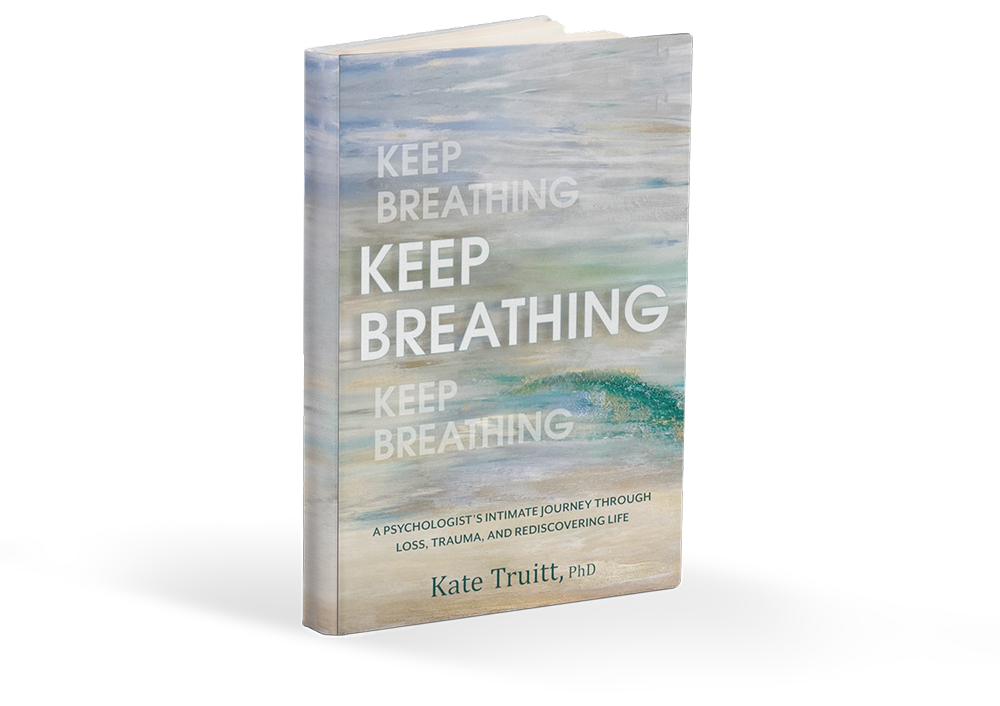
In my memoir, Keep Breathing, I share that journey more intimately—the moments where neuroscience met real life, and where the tools I teach became something I had to rely on, breath by breath. That experience reshaped not only how I understand grief, but how I sit with it—in myself and in others. If you’re holding space for loss in your work, and navigating your own layers of grief along the way, this book offers a more personal companion to the clinical lens.
📘 Keep Breathing: A Psychologist’s Intimate Journey Through Loss, Trauma, and Rediscovering Life
It’s an invitation to remember: You don’t have to be untouched by grief to guide others through it. Sometimes, it’s what allows you to meet them there with the deepest presence.