
When Grief Becomes Trauma
As clinicians and healers, you’ve likely witnessed the profound difference between grief that moves—and grief that immobilizes. A client loses someone suddenly. Another witnesses a traumatic death. Someone else carries unresolved grief layered with earlier trauma. In these moments, grief is no longer a linear emotional process—it becomes neurobiologically encoded distress.
This is the terrain of traumatic grief.
Traumatic grief occurs when the nervous system cannot fully process loss due to overwhelm. The brain’s survival networks override the natural mourning process, leaving individuals oscillating between hyperarousal (intrusion, anxiety) and hypoarousal (numbing, disconnection) (Shear, 2015). For those of us supporting others, understanding this distinction is essential—not just clinically, but compassionately.

The Neuroscience of Traumatic Grief
At its core, traumatic grief reflects a disruption in the brain’s integration systems. The amygdala, responsible for threat detection, becomes hyperactivated—coding the loss as ongoing danger rather than a completed event. Simultaneously, the hippocampus, which helps contextualize memory in time, struggles to properly encode the loss as “past” (van der Kolk, 2014).
This results in a haunting neurobiological loop:
- The loss feels present, not remembered
- Emotional responses feel immediate, not processed
- The body remains in a state of anticipatory threat
Meanwhile, the prefrontal cortex—critical for meaning-making and emotional regulation—often goes offline under this level of distress. In essence, the brain is not resisting grief—it is protecting against overwhelm. From an attachment lens, this becomes even more complex. The brain’s bonding circuitry (involving oxytocin and reward pathways) continues to seek the lost loved one, creating a painful mismatch between expectation and reality (O’Connor, 2019).
“Traumatic grief is not just about missing someone—it is about a brain that cannot reconcile their absence.”
Clinical Presentation: What We See in Practice
Traumatic grief often presents in ways that can be misinterpreted if we’re not attuned to its neurobiology. Clients may experience:
- Persistent intrusive images or memories of the loss
- Avoidance of reminders—or, conversely, compulsive proximity to them
- Emotional numbing or dissociation
- Guilt, self-blame, or “unfinished business”
- Difficulty engaging in meaning-making or future orientation
Importantly, these responses are adaptive attempts at regulation, not pathology. As clinicians, we are not “fixing” grief—we are supporting the nervous system in regaining its capacity to process it.
A Brain-Based Approach to Treatment
Effective work with traumatic grief requires moving beyond purely cognitive models into bottom-up, integrative approaches–integrating the full neurobiological experiences foundationally change sthe outcomes through harnessing the power of the NeuroTriad Model’s Brain Partnership approach. For example:
Stabilization Before Processing
Before engaging the narrative of the loss, ensure the nervous system has access to regulation.
This may include:
- Somatic grounding
- Breath-based interventions
- Bilateral stimulation
- Gentle orienting practices
These interventions support vagal regulation, allowing the brain to shift out of threat states.
Titrated Memory Integration
Rather than full exposure, traumatic grief work benefits from titration—engaging small pieces of the experience while maintaining regulation.
CPR for the Amygdala and the Sigh Breath + Mindful Touch Practices are neurobiologically designed tools for this exact practice.
Download these tools and other free healing resources, including a free Grief healing journal, here.
These practices allow the hippocampus to gradually encode the loss as a time-bound memory, rather than an ongoing threat.
Re-engaging the Attachment System Safely
Clinicians can support clients in transforming the relationship with the deceased from physical presence to internalized connection.
This may include:
- Imaginal dialogues
- Memory reconsolidation practices
- Rituals that honor continued bonds
Research suggests that maintaining a continuing bond is not maladaptive—it can be profoundly healing when integrated
Meaning-Making Through Neuroplasticity
Once regulation and integration are underway, the prefrontal cortex can re-engage.
Here, clients can begin to explore:
- Identity shifts after loss
- Post-traumatic growth
- Reconstructed narratives of connection and resilience
This is where healing moves from survival to transformation.

The Clinician’s Nervous System Matters Too
It’s important to acknowledge something often overlooked in clinical training: Holding traumatic grief is neurologically demanding. Mirror neuron systems and empathic attunement mean that as clinicians, we are not immune to the weight of these experiences (Decety & Jackson, 2004). Without intentional regulation, this work can lead to:
- Compassion fatigue
- Vicarious trauma
- Emotional constriction
Remember, your nervous system is not separate from the work—it is part of the intervention.
An Invitation for Deeper Clinical Integration
If this work resonates with you, and you’re ready to deepen how you hold traumatic grief—not just how you understand it—this is your next step. I’m hosting an immersive Traumatic Grief Retreat at the award-winning Blue Spirit Resort in Costa Rica, created specifically for clinicians and healers who want to integrate this work at a deeper, more embodied level.
Because this work is not just cognitive. It’s relational, somatic, and deeply human. For clinicians and healers seeking to expand their capacity, immersive environments offer something traditional training often cannot: Embodied integration. This is the opportunity to move from knowing the work… to truly experiencing and holding it. Together, we will:
- Deepen your understanding of the neuroscience of grief in a way that feels lived, not just learned
- Experience brain-based interventions firsthand, supporting true clinical integration
- Restore and regulate your own nervous system, especially if you’ve been holding space for others without enough space for yourself
- Build meaningful community with professionals who understand the complexity and responsibility of this work
Because the reality is—this work impacts us. And tending to your own nervous system is not separate from your clinical effectiveness—it is foundational to it. This retreat is not simply about adding tools to your practice. It’s about transforming your relationship to the work—so you can meet grief with greater steadiness, clarity, and compassion.
🔗 Learn more about the retreat and register here.
✈️ You can also explore our dedicated travel page, designed to guide you step-by-step—so you arrive grounded, supported, and ready to fully engage.

Closing Reflection
Traumatic grief is not a failure of coping—it is a reflection of how deeply the brain is wired for connection. As clinicians and healers, our role is to partner with the brain and gently support the nervous system in rediscovering safety, integration, and meaning. The brain already knows how to heal. Sometimes, it just needs the right conditions to begin.
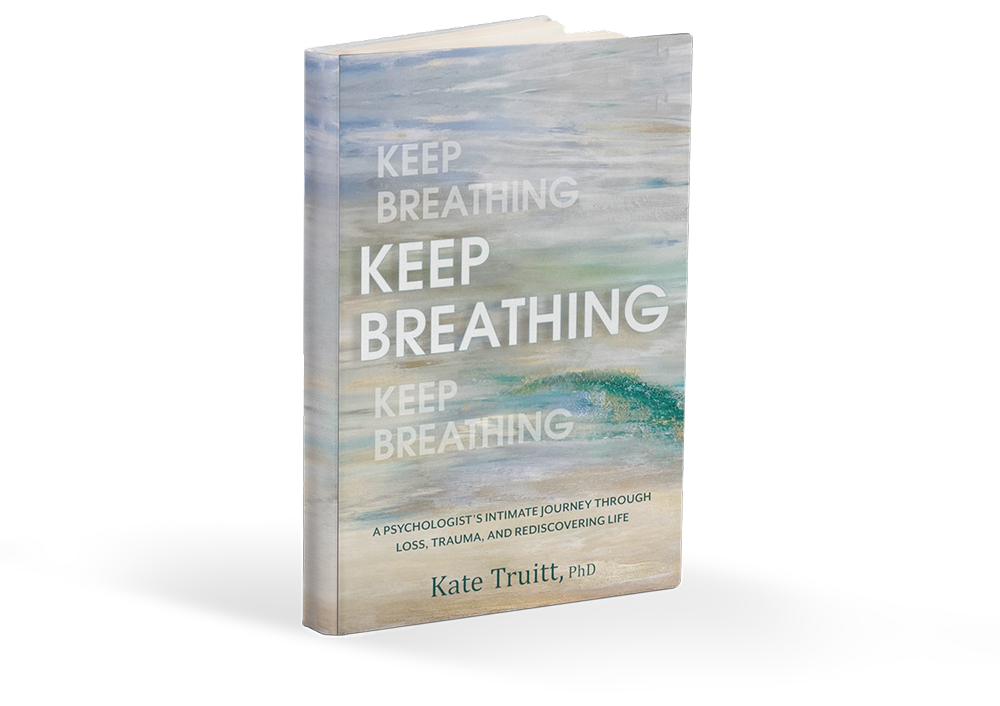
A Personal Note on Grief and Healing from Dr. Kate
If this work speaks to you, it may also be because you’ve lived close to grief yourself. I don’t just approach traumatic grief as a clinician—I come to it as someone who has walked through profound loss, disorientation, and the slow, nonlinear process of finding my way back.
In my memoir, Keep Breathing, I share that journey more intimately—the moments where neuroscience met real life, and where the tools I teach became something I had to rely on, breath by breath. That experience reshaped not only how I understand grief, but how I sit with it—in myself and in others. If you’re holding space for loss in your work, and navigating your own layers of grief along the way, this book offers a more personal companion to the clinical lens.
📘 Keep Breathing: A Psychologist’s Intimate Journey Through Loss, Trauma, and Rediscovering Life
It’s an invitation to remember: You don’t have to be untouched by grief to guide others through it. Sometimes, it’s what allows you to meet them there with the deepest presence.